
Jumping the (Virtual) Broom
Virtual platforms promise to let us socialize in ways that "go beyond what we can imagine". So what happens when we import our rituals into digital space?
On May 8, 1996 at 10:00pm CST, in a virtual online space called AlphaWorld, the first ever virtual wedding began.
Standing, or rather, floating, before a group of friends, Tomas Landhaus, 27, and Jeanette (Janka) Stanhope, 31, exchanged vows, each in custom-made avatars featuring a tuxedo and white dress. Around 50 attendees were present for the event, which also included an officiant, best man and bridesmaid, a wedding party, videographer and an (attempted) throwing-of-the-bouquet. Despite the novelty of the setting, a traditional essence was maintained, as one guest would go on to later reflect: “You may think me mad, but any kind of community and culture, real or virtual, is about presence and communication. Both were there that day in AlphaWorld.”
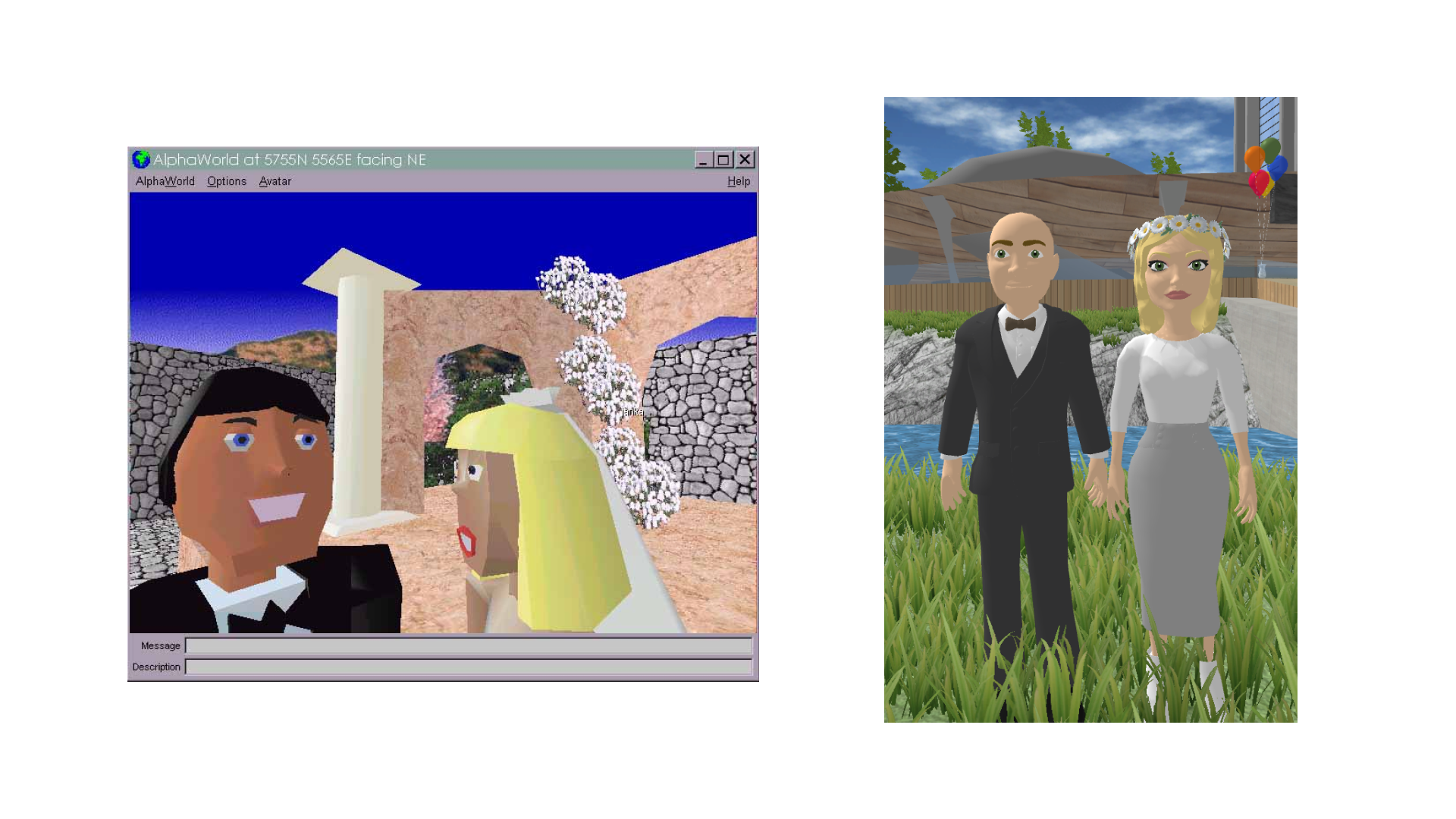
During the pandemic, commercial ventures have sought to transport the recognizable, social elements of our day-to-day lives into remotely accessible online worlds, with weddings, festivals, funerals and graduations getting their own online incarnations. A wedding in Facebook’s Metaverse, covered by the New York Times, claimed to underline “the possibilities of having a wedding unfettered by the bounds of reality’.
But online weddings shed these fetters before even the union of Tomas and Janka, albeit not in such vivid visual detail. MUD Forums, text-only chatrooms that date back to the 70s, often witnessed weddings featuring many of the details of traditional ceremonies. Sociologist Elizabeth Reid describes:
MUD weddings are simple in conception. The virtual bride and groom are usually married by another player who virtually reads, and actually types, the wedding ceremony. Textual descriptions of rings, or other tokens, are exchanged along with the vows. The wedding is usually attended by a number of fellow players, whose participation in the event strengthens its imaginative reality in the shared minds of the MUD community. The forthcoming nuptials are often publicized in the communications media, such as newspapers, which are internal to the MUD.1
In the 2020 coronavirus pandemic, few industries were hit as hard as the marriage industry. More than 83% of planned weddings were cancelled worldwide, representing a $30 billion dollar loss to the US wedding industry alone. With limited options, couples looked to the internet for salvation. Some took to streaming small in-person ceremonies, allowing distant family and friends to join remotely; a lucky few were even able to snag a fully-online zoom wedding during the brief period they were legal in New York. Creative wedding planners attempted to remedy the loss of the wedding’s strongest allure - the open bar - with innovative solutions like ‘wedding celebration boxes’, containing alcohol and props as a way to “include guests in a virtual wedding [as] you exchange vows via Zoom.”
The online wedding service Wedfully held over 700 weddings in 2020, and hopes to continue to provide a low-cost alternative to the traditional gathering when the pandemic subsides. However, despite the enthusiasm for online events, many couples couldn’t give up the ‘in-person’ element. Only 12% of the 7000 couples polled by The Knot decided to go ahead with an online wedding, with most choosing to wait until an in-person ceremony could be safely carried out.
Thinking about why couples might prefer to keep a wedding in the realm of reality reminds us that for many, weddings are rich, storied events that bring together communities in a celebration of ritual. The sociologist MW Barnes writes: “Traditional weddings bring families together – a role that has changed, but not decreased in importance as divorce and remarriage rates have climbed2”. As we age, convenable celebrations like birthdays wane, and events like weddings can be the only time family (biological or chosen) sees one another - a factor that may explain couples’ desire to hold out for a real-life event. Particularly in the light of the isolation and disruption that Covid has caused, one can imagine delaying a wedding to provide a venue for gathering once the pandemic subsides. As a bride interviewed by Barnes notes: “weddings are our family reunions – they’re the only time we see each other.”
However, not all weddings are traditional events. And for ceremonies that avoid tradition, and don’t - even can’t - center the family, perhaps the online wedding takes on a new significance. In ‘Coming of Age in Second Life’, writer Tom Boellstorff has described how weddings were popular among the gay and lesbian communities that flourished on the platform, in contrast with the way non-normative sexualities remained stigmatized throughout much of the world. While not specifically a queer space, online platforms “function as a fantastical/utopic space in which those who cannot legally marry in the physical world can fulfill their wish in the virtual. This positioning connects the space to the real world struggle for marriage equality3”.
The elements of online weddings that make them familiar - the white dresses, bouquets and rings - all help to make the ritual recognizable as it is transposed into a new platform. But if you’re importing a ritual into a new space, with an implied new meaning, why keep the signifiers of the ritual at all? Why not invent something new? In ‘The Wedding Complex’, Elizabeth Freeman writes about the idea of ‘queering marriage’, wherein she describes her time spent as an activist for gay marriage despite finding it politically suspect:
“While I did work for policies that would equalize gay and straight partnerships at my university, I also increasingly doubted that economic or social privileges should attend to these kind of relationships and not to others. […] Didn’t the wedding mystify heterosexuality, making it look natural, inevitable, and sacred?4”
As Freeman notes, much of wedding culture is a performance that can enshrine cultural values subliminally, without explicitly referencing them. Weddings have made the successful adaptation to the online world partially because of their dramaturgical nature, something the sociologist Erving Goffman called ‘front stage behavior’5. The wedding contains distinguishable elements like scenery, setting and costume that allow it to be recognizably transferred across platforms, conferring status. Much of what we tell ourselves about weddings is steeped in tradition, meaning that these same elements appear to have persevered throughout history, conferring collectivist feelings of nostalgia, and thereby authority, on the proceedings, regardless of platform. As the saying goes: ‘something old, something new’
Our cultural lore is what ties us. But does the saying even go like that? We may be aware that the history supporting these traditions is flimsy - but it’s maintained regardless. Tradition holds that western brides wear white dresses as a callback to an outmoded signifier of purity, but until the nineteenth century, women would simply wear their best dress to walk down the aisle, which in practice meant practical, darker shades for poorer women, and bright colors with extravagant stitching for wealthier ones.
Even the wedding charm ‘something old, something new’ is a historical red herring, again coined in the late nineteenth century. Charmingly, the full version includes the last line ‘and a silver sixpence in her shoe’, a detail that dates the rhyme out of antiquity.
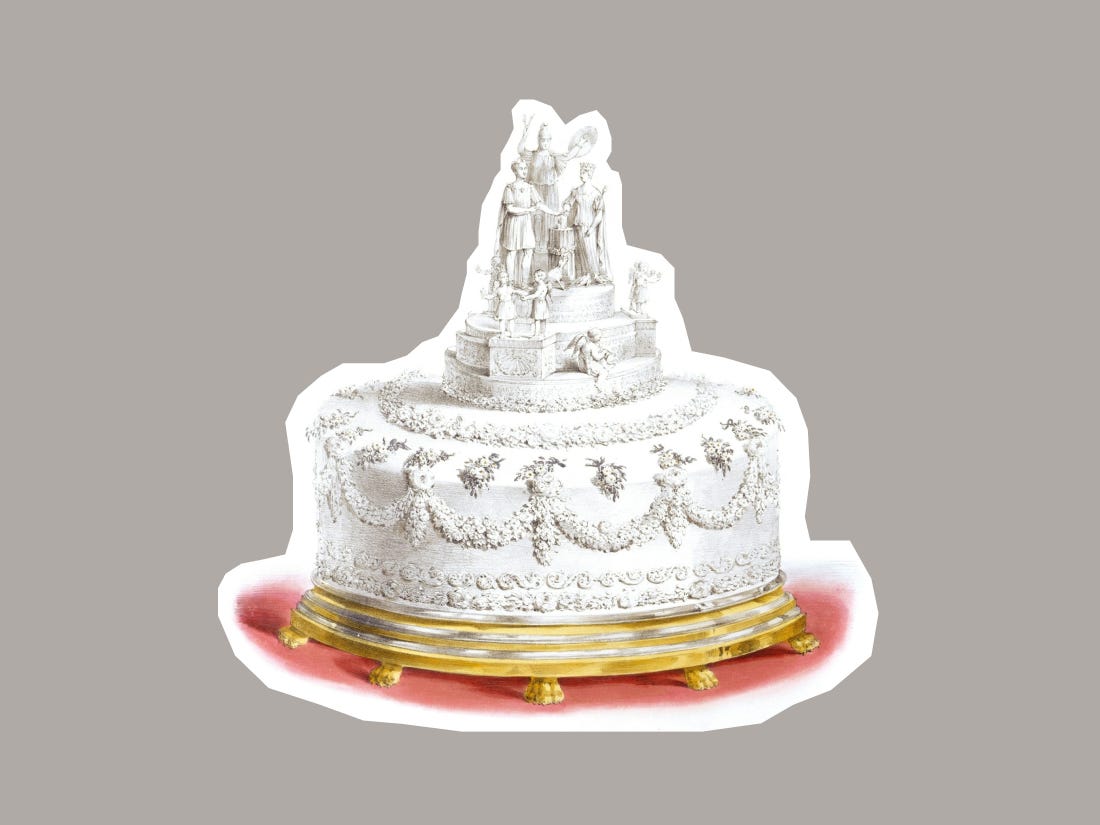
The reality is perhaps that rituals don’t gain credibility from truth - they act instead as continuations of traditions, which are embodiments of community values and mores. In his video promoting the Metaverse, Mark Zuckerberg tells us that, in augmented reality, we’ll be able to “feel present - like we’re right there with people, no matter how far apart we actually are”. A wedding in the Metaverse could take away some of the worst parts of the ceremony: the expense, weather, waste (more than $3m of wedding cake is thrown out each year). But for a community seeking a renewal of their customs (and contact), the platform will never be a replacement. In essence, rituals are who they serve: always representative of the community, a shared act of fabrication, solidarity borne from participating in the illusion.
For those communities who’ve formed bonds predominantly online, the adaptability of the wedding has renewed this form of celebration, bringing elements of digital and non-digital life together in ways all can recognize. Virtual reality fans speak of new platforms bringing currently unimagined ‘new’ ways to connect, but our digital histories tell us that we import directly from real-life culture, and adapt our known rituals to serve these new, altered communities.
Translating a piece of writing, or transposing a piece of music, asks for two types of expertise: exactitude and improvisation. On the frontier of new technology, it’s important to remember that our online spaces are not true mirrors: virtual spaces are most interesting when we examine the value that this difference brings, not the similarity. In the words of anthropologist Roy Rappaport, ‘humanity is a species that lives and can only live in terms of meanings it itself must invent’.
Barnes, MW, ‘Our Family Functions: Functions of Traditional Weddings for Modern Brides and Postmodern Families’, 2014, [link]
Jones, Donald, ‘Queered Virtuality: The Claiming and Making of Queer Spaces and Bodies in the User-Constructed Synthetic World of Second Life’, 2007, [link]